
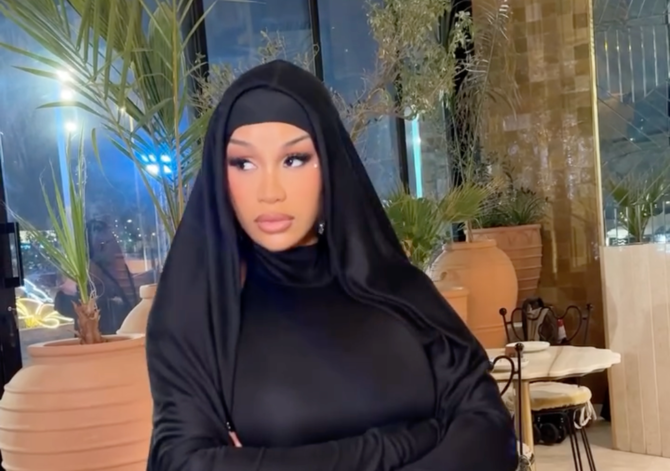
In an era marked by political retrenchment, hardened borders, and media narratives that flatten entire regions into symbols of danger or closure, culture is doing something quietly subversive: it keeps moving.
Cardi B performing in Saudi Arabia.
Tyla traveling to India and openly embracing her Indian heritage—an often overlooked but foundational cultural lineage within South Africa.
These moments are not pop-culture detours. They are signals.
They reveal a central truth of our time: cultural fluency—rather than cultural dominance—has become one of the most powerful forms of global influence we have.
And Gen Z, raised in an algorithmic world, understands this instinctively.
From the Bronx to Riyadh
View this post on Instagram
Cardi B’s presence in Saudi Arabia may have unsettled many observers—not because it was improbable in a globalized world, but because it disrupted the narrow narratives we’ve been taught to accept.
The Bronx-to-Riyadh pipeline isn’t supposed to exist according to conventional media logic. Saudi Arabia is often framed as closed, unsafe, or incompatible with expressions of Black, feminine, unapologetic cultural power. And yet, there she was—fully herself. Not diluted. Not translated. Not reshaped for anyone’s comfort.
What matters most is not that Cardi B went to Saudi Arabia. It’s that Saudi audiences welcomed her and that she openly, joyously, and fully embraced the culture – as only Cardi can do.
That exchange tells a deeper story than policy briefings ever could. It shows that people—especially young people—are far more culturally curious, porous, and open than the geopolitical narratives imposed upon them. Culture moves faster than ideology. And it lands very differently when it’s done by cultural actors embracing their truest authenticity.
Tyla, India, and the Visibility of Cultural Memory
View this post on Instagram
Tyla’s engagement with India operates on a different but equally important register.
By openly embracing her Indian heritage while connecting with Indian audiences, she made visible a cultural lineage that has always existed but is rarely centered: the deep presence of Indian communities within South Africa’s social and cultural fabric.
This wasn’t an act of global branding. It was recognition and embodiment.
In allowing her identity to remain layered and diasporic rather than singular or strategic, Tyla affirmed something Gen Z already understands—that culture is not fixed to one place at a time. It lives across histories, bodies, and geographies. And when artists move with that awareness, audiences respond.
Hip Hop Knew This First
Long before TikTok made cultural circulation visible in real time, hip hop was already doing this work.
One of the earliest examples I return to – and one of my personal favorites – is “Mundian To Bach Ke” by Panjabi MC featuring Jay-Z. Released at a moment when global pop was still largely organized around Western centers, the track moved effortlessly between Punjabi folk rhythms, South Asian diasporic sound, and African American hip hop. It wasn’t framed as “world music.” It wasn’t explained to death. It simply existed—and because of that, it traveled.
What made that collaboration powerful wasn’t novelty, but fluency. Jay-Z didn’t dilute himself. Panjabi MC didn’t flatten his cultural inheritance for mass consumption. The song trusted audiences to meet it where it was. And they did—across continents, languages, and communities.
That lineage matters.
Cardi B in Saudi Arabia and Tyla in India are not anomalies. They are inheritors of a long diasporic practice. African and African-diasporic artists have always understood how to move across cultures without erasing themselves—how to bring home with them, rather than leaving it behind.
TikTok, Gen Z, and the Algorithm as Ambassador
Platforms like TikTok didn’t invent cultural fluidity. They simply removed the gatekeepers.
A sound created in Johannesburg can trend in Mumbai.
A dance born in Atlanta can become ritual in Jakarta.
What travels isn’t polish or political alignment—it’s resonance. Feeling. Specificity. Truth.
Gen Z – and arguably many Millennials – aren’t interested in sanitized globalism. They are drawn to people who carry their full selves into new spaces, who allow culture to circulate without flattening it into something safe or legible for everyone at once.
In this sense, the algorithm has become a kind of cultural ambassador—doing the work diplomacy often cannot.
Cultural Expansion in an Age of Political Retraction
This is the paradox of our moment: while governments retract, culture expands.
Borders tighten. Visas shrink. Language hardens.
And yet commerce, creativity, and cultural exchange continue to cross borders daily.
For brands and cultural organizations, this is not a contradiction to ignore—it’s a call to pay attention.
What would behoove them now is recognizing that cultural expansion does not wait for political permission. The future belongs to those who understand culture as a living, relational force—one that builds awareness first, and influence second.
No place is perfect. No society is without contradiction. But when artists and cultural leaders show up with fluency, respect, and openness to exchange, they do something more lasting than spectacle.
They widen the frame.
Ayofemi Kirby is Founder and Chief Strategist of ElevenThirtySix. For ongoing cultural intelligence and applied frameworks for leaders shaping culture, subscribe to Ayofemi’s Substack.