
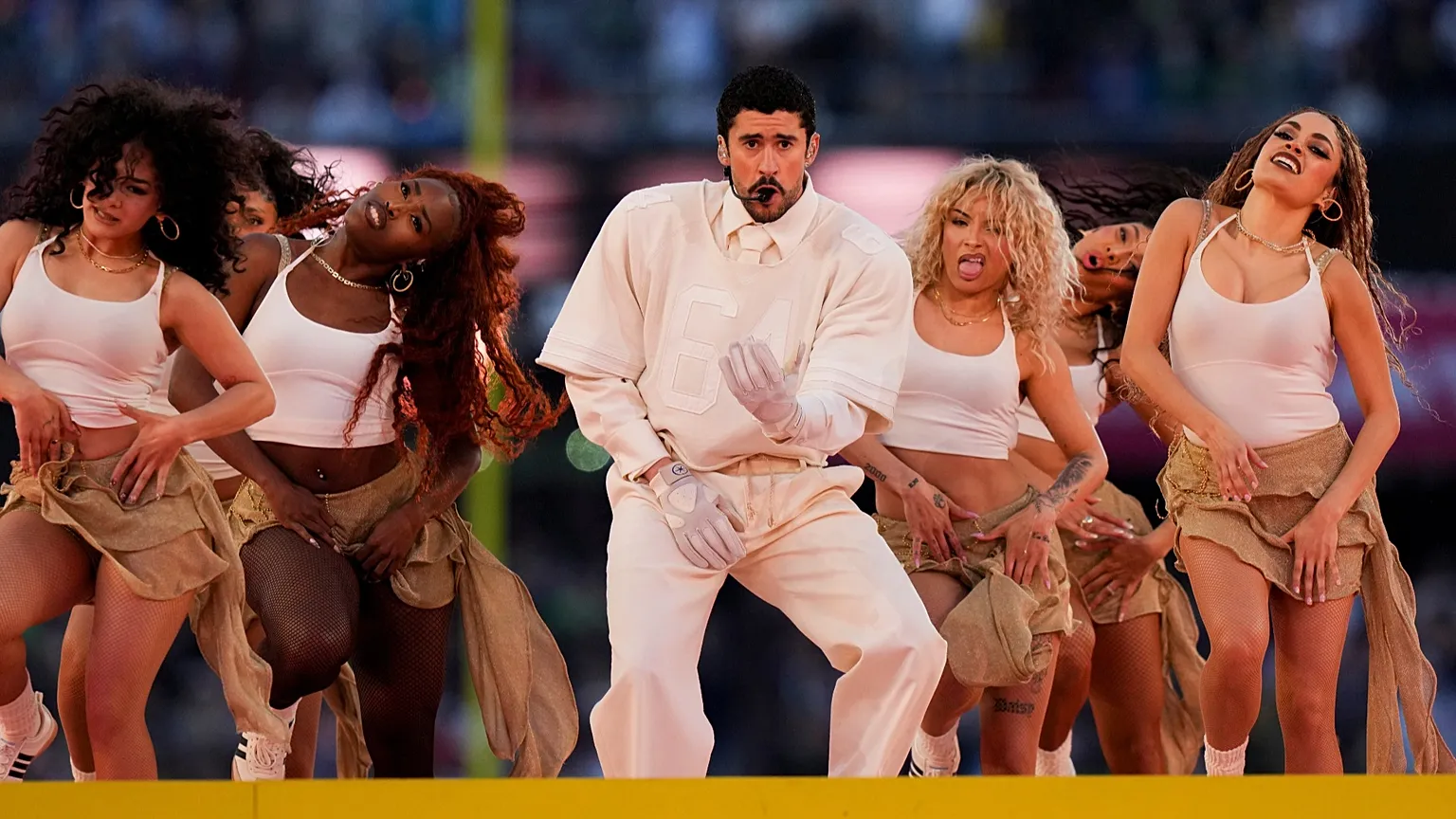
Like many of you over the past two weeks, I’ve watched Bad Bunny’s Super Bowl performance several times. Each time, I find myself tearing up at a different moment.
Part of it is personal. Over the years, I’ve spent time visiting and living in places like Puerto Rico, Cuba, Peru, Senegal, India, South Africa, and Portugal, among many other countries that have deepened my understanding of how we all have been shaped by centuries of global movement, collision, and exchange.
They are places where Indigenous, African, European, Asian and Latin histories don’t sit neatly beside each other. They overlap. They mix. They live inside the same language, the same music, the same gestures. You can feel it immediately when you’re there.
So when I watched that performance, I wasn’t just seeing Puerto Rico. I was seeing the story of how cultures come into being, through contact, migration, survival, and reinvention.
And that’s what made it so powerful.
This performance was deeply specific, rooted in place and history, yet it resonated far beyond that place because so many of us could recognize something of ourselves inside it.
That tension between what belongs to a particular community and what speaks to all of us sits at the heart of one of the most important questions we face in cultural work:
Who does culture really belong to?
There’s a comforting idea that cultures are fixed, that they belong entirely to one group, one nation, one lineage. But when you look closely, history tells a different story.
Most cultural traditions are not isolated creations. They are the result of exchange: trade routes, migration, colonization, resistance, adaptation. They emerge from people meeting, clashing, borrowing, and reinterpreting over time.
It’s one of the reasons why the cosmopolitan cities around the world such as New York, Paris, Dakar, Havana, Lisbon are so rich with texture, languages, and experiences that have no definitive origin, but have somehow combined to create a unique fabric that offers layers it would take a lifetime to explore.
The truth is that culture has never been pure. It has always been layered, shared, and evolving.
And yet, at the same time, cultural expression is deeply rooted in specific communities, in our histories, our struggles, our memories.
Both of these things are true. Culture is both particular and collective.
For those of us who lead cultural institutions, shape narratives, or steward creative spaces, this tension shows up constantly.
We are asked to honor cultural specificity, to tell stories that are grounded, accurate, and respectful of the communities they come from.
At the same time, we are also trying to create connection, to help people who may not share that history still see themselves reflected, still feel invited into understanding.
This is delicate work. If we lean too far toward universality, we risk flattening difference. If we lean too far toward ownership, we risk building walls where bridges might exist.
The real challenge is holding the paradox that culture is both rooted and relational, grounded in particular histories, yet capable of connecting us far beyond them.
This is where leadership becomes essential.
The stories our institutions tell through exhibitions, programs, communications, and public narratives, shape how communities see themselves and how they see each other.
We are not just preserving culture. We are actively shaping how it is understood and shared.
That means asking deeper questions:
- How do we tell stories with precision and care without making them inaccessible?
- How do we honor the histories of specific communities while helping others feel connected to them?
- How do we create narratives that hold complexity rather than simplifying it?
These are not technical questions. They are questions of perspective, responsibility, and imagination.
Watching Bad Bunny’s performance (for the 100th time), I kept thinking about how rare it is to see cultural expression on a global stage that refuses to choose between rootedness and openness.
It didn’t dilute its specificity. It didn’t explain itself.
It simply showed what it meant to exist at the crossroads of many histories and trusted that people would recognize something familiar inside it.
That is what powerful cultural work does.
It allows us to see the uniqueness of a place while also reminding us that our stories are deeply intertwined.
Resource: One of my favorite resources on this question of cultural belonging and shared heritage is Kwame Anthony Appiah’s essay “Whose Culture Is It, Anyway?” If you’re interested in exploring these ideas more deeply, I highly recommend reading the full text here.
An Invitation
This April, I’ll be working with a small number of cultural, civic, and creative leaders seeking deeper strategic clarity and perspective in their work.
If this sounds like you, send me a message and tell me: what is the most challenging aspect of your work right now? I read every response.
For ongoing cultural intelligence and applied frameworks for leaders shaping culture, subscribe to Ayofemi’s Substack.